
Table of Contents
ToggleFirst blood pressure reading high, second normal? Which reading should you trust?
Your monitor says 142/88. A minute later, it says 118/76. You haven’t taken any medicine or left your chair, yet the numbers tell different stories.
A first blood pressure reading can be high, second normal because you’ve had more time to rest, feel less tense, or have changed your position. Both results deserve attention. A lower second reading doesn’t automatically cancel the first.
Record both readings and look at the pattern across properly measured sessions. The American Heart Association recommends 2 readings, 1 minute apart, each time you check at home.
You’ll find the measurement steps below, along with examples showing how to interpret the difference and decide when to seek help.
Get urgent help: Very high blood pressure with chest pain, trouble breathing, weakness, or difficulty speaking can be an emergency. Call 911 rather than waiting for a better number.
Why is the first BP reading higher than the second?
You wonder : Why there are different blood pressure readings within minutes ? Several things can push the first result up. Sometimes the explanation is as simple as sitting down and pressing Start too quickly.
Your body is still settling
Walking upstairs, rushing to find the cuff, or getting out of a busy conversation can leave you measuring before you’ve rested. The CDC advises sitting quietly with your back supported for at least 5 minutes beforehand.
If you start immediately, the second reading happens after you’ve spent longer sitting. That difference in preparation can affect what you see.
The same applies to talking or shifting position. Answering a question during the first measurement and sitting silently for the next creates different measurement conditions.
Taking the measurement makes you tense
Seeing the cuff tighten or worrying about the result can trigger an alerting response. Your nervous system reacts to the situation, and blood pressure can rise temporarily.
That reaction can settle during repeat measurements. It doesn’t happen to everyone, and it doesn’t explain every large difference.
White-coat hypertension has a more specific meaning: blood pressure is high in a clinical setting and lower outside it. Two different results taken at your kitchen table can’t establish that diagnosis.
Your position or cuff setup changes
An unsupported arm, crossed legs, or talking can affect the result. If you correct your position before repeating the measurement, you’re comparing readings taken under different conditions.
Cuff size matters too. A cuff that’s too small can overestimate pressure; one that’s too large can underestimate it. Check the arm-size range printed on the cuff or in the instructions.
A persistent setup problem may affect both readings. Getting a lower number on the second attempt doesn’t prove that the cuff fits correctly.
Blood pressure varies between measurements
Blood pressure changes as your body responds to activity and rest. Even carefully taken readings won’t always match.
A 2024 study examined 1,553 primary-care encounters with a high initial reading. On average, the second reading was 6.2 mmHg lower for systolic pressure and 3.0 mmHg lower for diastolic pressure.
Those numbers describe a group of clinic measurements. The study didn’t establish how much your home reading should fall, and rest before the first measurement wasn’t standardized.
The researchers also discussed regression to the mean: an unusually high result may be followed by one closer to a person’s usual level. Never subtract a fixed number from your reading to “correct” it.
Which BP reading is more accurate: the first or second?
Neither reading is automatically more accurate because of its place in the sequence. Accuracy depends on the device and how you take the measurement.
The second may better reflect a rested state if you rushed the first. It may also be affected by movement, a different arm position, or another measurement problem.
Give your clinician the complete record. Choosing whichever result feels reassuring removes information that could help explain the pattern.
Should you discard the first blood pressure reading?
For routine home monitoring, AHA instructions say to record both readings. If your clinician has given you a particular monitoring protocol, follow it consistently.
You may have heard that the first reading should always be ignored. Some measurement protocols exclude particular readings, but that isn’t a universal rule for everyone checking at home.
There’s also a separate instruction that gets mixed into this advice: discarding the first day.
For diagnostic home monitoring, the UK’s NICE guideline recommends 2 seated readings at least 1 minute apart, morning and evening, for at least 4 days and ideally 7. It then excludes all measurements from day 1 and averages the remaining readings.
That instruction concerns a complete day’s data. It doesn’t tell you to delete the first reading from every pair.
What if your home and clinic readings disagree?
Bring the home record to your appointment. In adults being assessed for hypertension, the US Preventive Services Task Force recommends measurements outside the clinic to confirm the diagnosis before starting treatment.
Your clinician may suggest a structured home schedule or ambulatory monitoring. An ambulatory monitor automatically measures pressure through daily activities and sleep, usually over 12 to 24 hours.
This can help clarify a pattern that a few isolated measurements leave uncertain. Urgent symptoms or severely high readings need prompt assessment, even if a monitoring plan hasn’t been completed.
Do not engage yourself in conversation that which BP reading is more accurate, first or second ? Keep them both recorded for your better health visit.
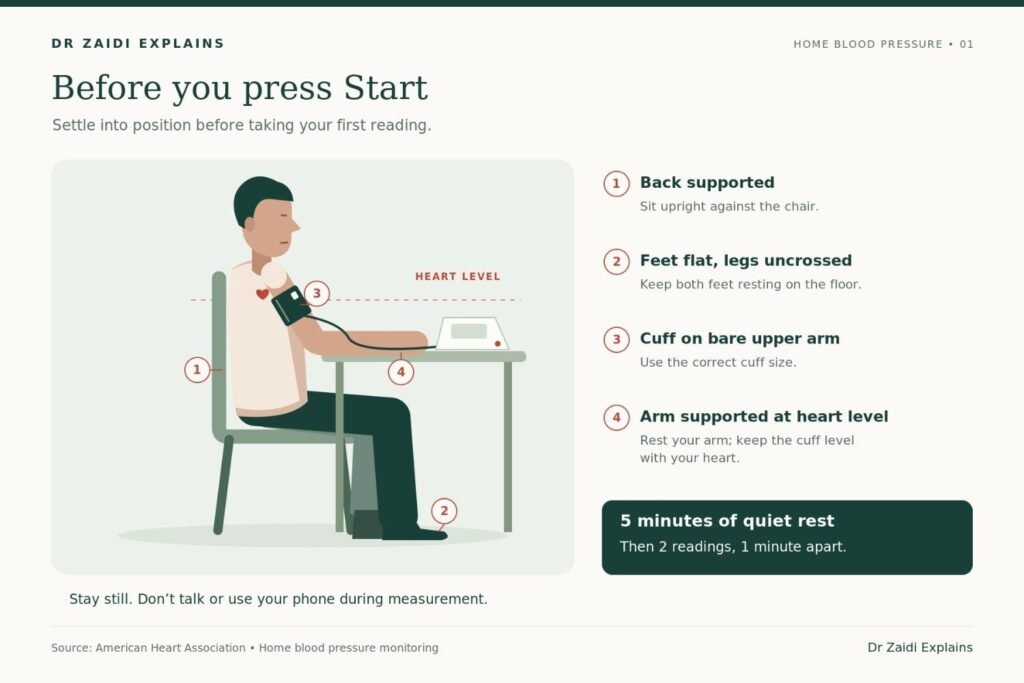
How to recheck your blood pressure correctly
Set up your chair and monitor before you start. A repeatable routine makes the results easier to compare.
- Check your equipment. Use a validated automatic upper-arm monitor with a cuff that fits your arm. You can check devices through the US Blood Pressure Validated Device Listing at Validate BP.
- Prepare beforehand. Avoid smoking, caffeine, and exercise for at least 30 minutes. Empty your bladder.
- Rest for at least 5 minutes. Sit with your back supported, feet flat, and legs uncrossed.
- Position your arm. Place the cuff against bare skin and support your arm so the cuff is at heart level. Follow the manufacturer’s fitting instructions.
- Stay quiet. Avoid talking or using your phone during the measurement.
- Repeat after 1 minute. Keep the same position and record both results.
Use the arm your clinician recommends. Keep it consistent when comparing sessions, unless you’ve been instructed otherwise.
If you realize you talked or moved, add a note beside that reading. Follow the monitor’s instructions for an error message or interrupted measurement. A note helps distinguish a questionable measurement from an unexplained change.
Make the log easy to review
A notebook works. Your clinician should be able to see the date, time, both measurements, and any relevant circumstances without guessing what happened.
Here’s an example of a useful entry:
| Date and time | Reading 1 | Reading 2 | Notes |
|---|---|---|---|
| Monday, 8:00 a.m. | 142/88 | 118/76 | Same arm; seated rest completed; no symptoms |
Keep medication timing in the record if your clinician asks for it. Follow the agreed schedule and usual prescription instructions.
Before your appointment, check whether your monitor stores readings automatically. Taking the device with you can make it easier to compare its saved results with your written log.
Different blood pressure readings within minutes: what the numbers mean
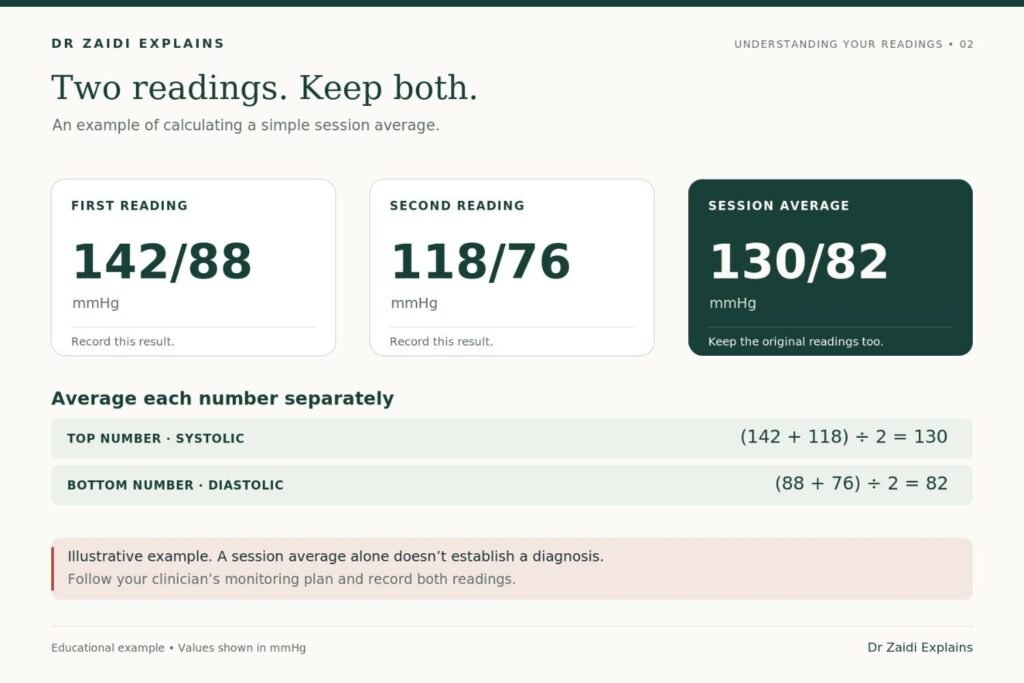
A change between readings can feel dramatic, especially when one appears in a different category. Write down the actual numbers before deciding what they mean.
These are arithmetic examples, not patient cases or diagnoses:
| First reading | Second reading | Simple session average |
|---|---|---|
| 142/88 | 118/76 | 130/82 |
| 128/78 | 116/74 | 122/76 |
| 148/94 | 140/90 | 144/92 |
For the first pair, calculate each number separately:
- Systolic: (142 + 118) ÷ 2 = 130 mmHg.
- Diastolic: (88 + 76) ÷ 2 = 82 mmHg.
Keeping only 118/76 would leave the higher result out of the record. Keeping only 142/88 would leave out the change that followed.
A simple session average is a way to describe that pair. Diagnosis and treatment require the wider measurement record and your clinical circumstances. Keep the individual readings even when you calculate an average.
Blood pressure chart for adults
The following categories use US adult guidance. Systolic is the top number; diastolic is the bottom number.
| Category | Systolic pressure | Relationship | Diastolic pressure |
|---|---|---|---|
| Normal | Below 120 | And | Below 80 |
| Elevated | 120–129 | And | Below 80 |
| Stage 1 hypertension range | 130–139 | Or | 80–89 |
| Stage 2 hypertension range | 140 or higher | Or | 90 or higher |
All measurements are in mmHg. If the numbers fall in different categories, the higher category applies.
For example, 118/86 falls in the stage 1 range because of the diastolic number. A lower systolic value doesn’t erase that information.
These labels describe ranges. A single result in one of them doesn’t establish a hypertension diagnosis. Your clinician also considers repeated measurements and the setting in which they were taken.
Guidelines differ between countries. NICE, for example, uses a home-monitoring average of 135/85 or higher alongside a clinic reading of 140/90 or higher to confirm hypertension.
When should you contact a clinician or get urgent help?
Repeatedly high readings deserve a conversation with your healthcare professional. Contact them sooner if readings rise substantially above your usual level or you develop symptoms.
If the first reading is high and the second normal
Keep both results. If the pattern keeps happening, bring the record and your monitor to an appointment so your technique and equipment can be checked.
A short note can make the conversation more productive: “My first reading is regularly higher, even after resting. Can we check my cuff and agree on which measurements to average?”
Ask how often to measure and which results should prompt a call. Having those instructions written down reduces the need to decide afresh after every unexpected number.
If a reading is severely high
If systolic pressure is above 180 or diastolic pressure is above 120 and you have no concerning symptoms, wait at least 1 minute and repeat the measurement. If it remains that high, contact your healthcare professional immediately.
If very high pressure comes with chest pain, breathlessness, weakness, numbness, vision changes, or difficulty speaking, call 911. Don’t delay emergency care to finish a log or calculate an average.
A later lower result doesn’t make ongoing emergency symptoms safe to ignore.
This guide concerns general adult home monitoring. During pregnancy or after delivery, follow your maternity team’s blood pressure instructions; don’t use the severe threshold above as a reason to wait for help.
If your readings keep running high
Ask your clinician about a treatment plan. Continue prescribed blood pressure medicine unless your prescriber changes it, even when some home readings look normal.
For longer-term dietary support, the DASH eating plan includes vegetables, fruit, whole grains, beans, and other everyday foods. Research supports DASH and reduced sodium intake for lowering blood pressure.
Start with a manageable change, such as comparing sodium labels on foods you buy regularly. Discuss dietary restrictions with your care team if you have kidney disease or other conditions affecting what you can eat.
Frequently asked questions
Why is my first BP reading always higher than my second?
Extra rest, measurement anxiety, or a change in technique may explain a recurring difference. The first reading isn’t always higher for everyone. Keep a consistent routine and show repeated differences to your clinician, especially if they persist after your measurement technique has been checked.
Can anxiety raise blood pressure at home?
Yes. An alerting response can happen when you worry about the cuff or anticipate a high result. A higher number alone can’t show that anxiety caused it. Record the reading and follow your agreed monitoring plan so your clinician can assess the pattern.
What if my second blood pressure reading is higher?
Record it too. Movement, talking, and ordinary variation can affect either measurement. Add a note if something interrupted the reading. The order of the results doesn’t decide whether one should count, and a severely high second reading needs the same attention as a severely high first one.
What is normal blood pressure by age?
The US adult normal category is below 120 systolic and below 80 diastolic. There isn’t a separate normal category for each adult decade. Your treatment target may be individualized, particularly with frailty or other health conditions. Children’s readings require age-specific interpretation, so this adult chart doesn’t apply to them.
Should I keep checking until my blood pressure is normal?
Follow the number of measurements in your agreed plan. Taking extra readings and keeping only the lowest creates an incomplete record. If an unexpected result worries you, use the repeat-measurement and urgent-care guidance above, or contact your healthcare professional for instructions.
Your next step
If your first blood pressure reading is high and your second is normal, keep both numbers. Use the same careful routine at your next scheduled session and share recurring differences with your clinician.
Bring your log and monitor to the appointment. Ask for a clear schedule and specific instructions about when to call, so you know what to do the next time the numbers disagree.
References :
- American Heart Association: Home blood pressure monitoring
- CDC: Measuring your blood pressure
- Alexander and colleagues: Predictors of blood pressure reductions with a second measurement, Vascular Medicine, 2024
- American Heart Association scientific statement: Measurement of blood pressure in humans
- NICE NG136: Hypertension in adults, recommendations
- US Preventive Services Task Force: Hypertension in adults, screening
- American Heart Association: When to call 911 about high blood pressure
- American Heart Association: Understanding blood pressure readings
- NHLBI: Health benefits of DASH
- 2025 AHA/ACC guideline: Home blood pressure monitoring instructions
- ACOG: Preeclampsia and high blood pressure during pregnancy