A1C high but fasting glucose normal? Causes and next steps
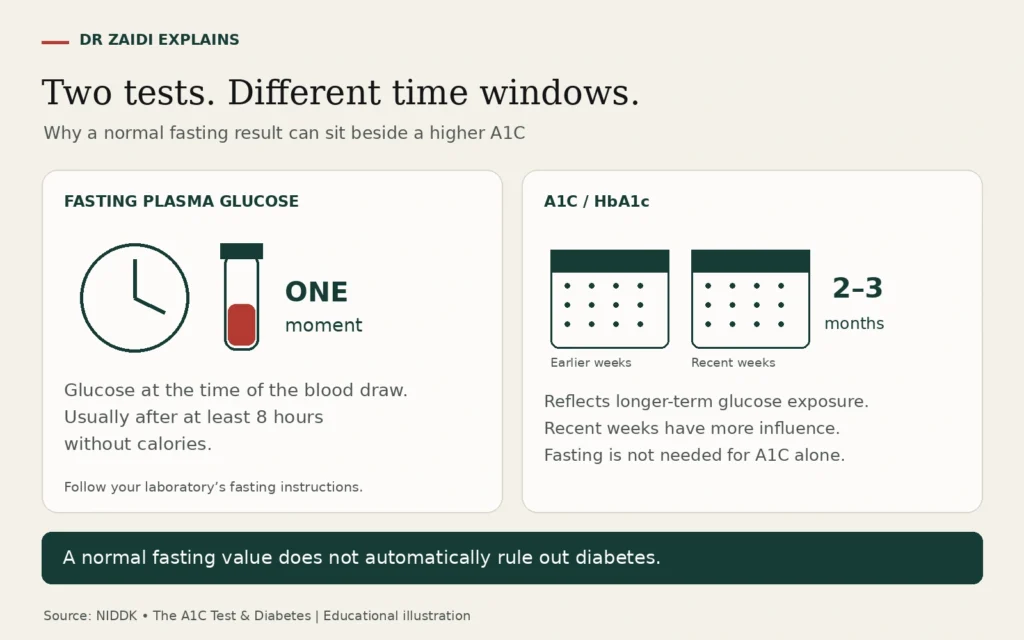
A1C high but fasting glucose normal? The tests can disagree because they capture different periods of your blood sugar history. Glucose may rise after meals, recent improvements may take time to show fully in A1C, or a blood-cell condition may affect the result.
A normal fasting value doesn’t automatically rule out diabetes. The actual numbers, previous results, and whether A1C is reliable for you determine what happens next.
Seeing a reassuring glucose result beside a flagged A1C can leave you wondering which one to believe. Before changing your diet dramatically or deciding the laboratory made a mistake, look at what each test measured.
Can your A1C be high when fasting glucose is normal?
Yes. You can have an A1C above its normal range while fasting glucose remains below 100 mg/dL. The tests sometimes identify different people as having a glucose problem.
The word “high” needs a number beside it. An A1C of 5.7% sits at the beginning of the prediabetes range. An A1C of 6.5% reaches the diabetes diagnostic threshold. Those results call for different discussions.
If you’ve already been diagnosed with diabetes, your personal treatment goal is another consideration. A screening cutoff and a treatment target answer different questions.
Start with the full report. Check whether the glucose result came from a fasting laboratory sample or a home reading, and whether it was taken on the same date as your A1C.
A1C vs fasting glucose: what each test tells you
A1C measures the percentage of hemoglobin with glucose attached to it. Hemoglobin is the oxygen-carrying protein inside red blood cells. The result helps estimate glucose exposure over roughly the previous 2–3 months.
Fasting plasma glucose measures the glucose in your blood when the sample is collected, after the required fast.
| Test | Period covered | Preparation | What it cannot show by itself |
|---|
| A1C, also called HbA1c | Roughly 2–3 months | Fasting usually isn’t needed for A1C alone | When glucose rises or falls during the day |
| Fasting plasma glucose | The time of the blood draw | At least 8 hours without calories, following laboratory instructions | Glucose patterns after meals or on other days |
A normal morning measurement can coexist with higher readings later. A1C also depends on red blood cells, so conditions affecting those cells can complicate its interpretation.
For nonpregnant adults, these are the usual diagnostic ranges:
| Category | A1C | Fasting plasma glucose |
|---|
| Below the prediabetes threshold | Below 5.7% | Below 100 mg/dL |
| Prediabetes range | 5.7–6.4% | 100–125 mg/dL |
| Diabetes range | 6.5% or above | 126 mg/dL or above |
The rows show separate criteria; both tests don’t have to fall in the same row. A diabetes diagnosis generally requires confirmation unless symptoms and glucose findings already establish it.
Why high A1C and normal fasting glucose can happen
The causes of high HbA1c with normal blood glucose include changes in glucose across the day, recent changes in your health, and factors that affect A1C accuracy. A single pair of results can’t tell you which explanation applies.
Glucose rises outside the fasting window
Your fasting sample leaves most of the day unmeasured. If glucose repeatedly stays higher after meals, that exposure can affect A1C even when morning glucose is normal.
For example, someone who checks only before breakfast has little information about the hours after lunch or dinner. Their morning readings may be accurate and still give an incomplete picture.
Insulin resistance can contribute to difficulty handling glucose, but the mismatch alone doesn’t establish insulin resistance. Your clinician will consider your history and other findings.
For background, read our guide to type 1 and type 2 diabetes.
Your glucose has improved recently
A1C takes account of earlier weeks as well as recent ones. A change in treatment or daily habits can improve today’s glucose while the A1C still includes a period when glucose was higher.
Recent weeks have more influence on A1C than older weeks. Changes can therefore appear before 3 months have passed, although one week of better readings won’t tell you exactly what the next A1C will be.
Bring dates. “I started treatment 2 weeks before the blood draw” gives your clinician more information than “my glucose is better now.”
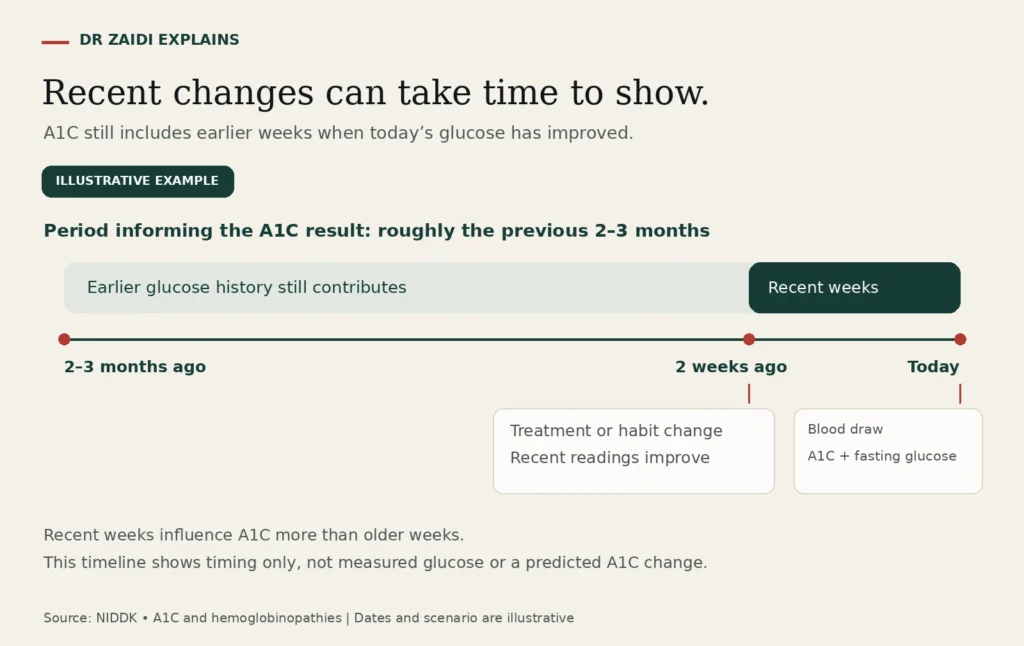 Illustrative example. Recent weeks have more influence on A1C; the timeline does not show measured glucose or predict a result.
Iron deficiency affects the result
Iron-deficiency anemia can make A1C higher than glucose measurements would suggest. It can also coexist with a genuine glucose problem.
Mention known anemia, heavy menstrual bleeding, or previous iron treatment. Your clinician can decide whether blood-count or iron testing fits your situation. An unexpected A1C alone isn’t a reason to start iron supplements.
Other blood-cell changes have different effects. Recovery from blood loss and hemolytic anemia, where red cells break down early, generally lower A1C. Treating all anemia as a cause of falsely high A1C would miss that distinction.
A hemoglobin variant affects the testing method
Some people inherit a form of hemoglobin that affects certain A1C laboratory methods. Depending on the variant and method, the result can be higher, lower, or unaffected.
Suitable methods exist for many hemoglobin variants. If you know you have a hemoglobin trait, tell your clinician and ask whether the laboratory’s method is appropriate.
The results reflect different circumstances
A comparison becomes harder when the readings come from different dates or methods. A recent home reading and a laboratory A1C collected several weeks earlier don’t cover the same period.
Illness and medicines can also change glucose. Some medicines, including glucocorticoids, can increase it. Bring the names and start dates of prescriptions, including recent steroid treatment.
Keep taking prescribed medicines unless your clinician advises a change.
What different combinations of results can mean
These fictional examples show how to read the question raised by a result. They aren’t patient stories or individual diagnoses.
The ranges follow standard diagnostic criteria.
If you’re searching for “5.7 A1C but normal glucose,” ask how the result compares with earlier tests. A small change near a cutoff deserves context.
A diabetes-range result needs timely follow-up. Your clinician may repeat the A1C and investigate interference. When reliable repeat A1C results meet the diabetes threshold, a lower fasting glucose doesn’t cancel them out.
Want to estimate your HBA1c without hassle of going to laboratory, check out our free HBA1c calculator
How clinicians investigate results that do not match
The first step is to check the reports together. The collection dates, fasting instructions, previous values, and symptoms can change how the numbers are interpreted.
Your clinician then decides which unanswered question needs testing.
| Clinical question | A test or review that may help |
|---|
| Does the abnormal diagnostic result repeat? | Repeat laboratory testing, selected according to the original findings |
| Does fasting glucose miss a problem handling glucose? | A standardized oral glucose tolerance test |
| Could anemia or iron deficiency affect interpretation? | Blood count and iron studies when the history supports them |
| Could a hemoglobin variant affect A1C? | Review of the laboratory method and relevant hemoglobin testing |
An oral glucose tolerance test measures your response to a measured glucose drink. An ordinary after-meal home reading doesn’t reproduce that test.
When A1C is unreliable, clinicians use appropriate plasma-glucose criteria for diagnosis. Other markers, such as fructosamine or glycated albumin, can sometimes help with shorter-term monitoring; they have their own limitations.
Continuous glucose monitoring may help reveal patterns. The American Diabetes Association states that evidence is insufficient to use CGM for screening or diagnosing prediabetes or diabetes.
Ask what each proposed test would clarify. That keeps the discussion focused on your results and history.
What to bring to your appointment
Save the actual laboratory reports, including the units and reference ranges. If you have home readings, bring the record with dates and times instead of only your highest or lowest value.
Use this checklist:
- A1C and glucose reports, including earlier results.
- Whether you fasted and for how long.
- Home readings with meal timing, if available.
- Prescription medicines, supplements, and recent medication changes.
- Recent illness, surgery, blood donation, bleeding, or transfusion.
- Known anemia, hemoglobin traits, and pregnancy status.
- Symptoms, when they began, and any unexplained weight change.
You can open the conversation with: “These results seem different. Which result needs confirmation, and could anything affect the accuracy of my A1C?”
Before you leave, get a follow-up date and instructions about symptoms that should prompt earlier care. If another test is ordered, ask about preparation before changing your usual routine.
Download appointment checklist : Download here
Can an A1C calculator explain the difference?
An A1C calculator converts A1C into estimated average glucose, usually shortened to eAG.
For example, an A1C of 6.0% corresponds to an eAG of approximately 126 mg/dL using the standard conversion. That estimate covers glucose exposure across the day. A fasting value of 95 mg/dL measures a different quantity, so the two numbers aren’t expected to be identical.[8]
Our HbA1c calculator can help you understand the conversion.
The calculator cannot detect anemia, confirm diabetes, or tell you what happened after dinner. It also cannot independently verify the A1C you enter. If something has distorted that result, converting it into another unit won’t resolve the problem.
When should you get medical help?
Contact the clinician who ordered the test to discuss a newly abnormal A1C. Arrange prompt assessment if you also have increased thirst, frequent urination, blurred vision, or unexplained weight loss.
People searching for “high A1C symptoms” are usually asking about symptoms of high blood glucose. Some people have none, even when testing identifies a problem. Feeling well doesn’t settle the meaning of an abnormal result.
Seek emergency care for trouble breathing, vomiting with an inability to keep fluids down, or fruity-smelling breath, especially with other symptoms of diabetes. These can occur with diabetic ketoacidosis, a potentially life-threatening emergency.
Don’t wait for a routine repeat A1C when you’re acutely unwell.
Frequently asked questions
What causes high A1C but normal glucose?
Possible explanations include glucose elevations outside the fasting window, recent improvement in glucose, or a condition affecting A1C interpretation. The pattern of repeated results and your medical history help your clinician decide which explanation to investigate.
What is a dangerous level of A1C?
There isn’t a single A1C cutoff that tells you whether you’re having an emergency today. An A1C of 6.5% or above reaches the diabetes diagnostic threshold and needs appropriate assessment.
For someone with established diabetes, a result above their agreed target calls for a treatment review. Immediate danger depends on current symptoms and glucose-related complications, so acute illness needs attention regardless of the last A1C result.
What is a normal A1C level for a woman?
For a nonpregnant adult woman, an A1C below 5.7% is within the usual normal diagnostic range, the same cutoff used for men. A woman who already has diabetes may have a different personal treatment target.
Pregnancy changes testing and treatment decisions. Follow your maternity team’s advice; this general table doesn’t replace pregnancy-specific testing.
What happens when A1C is too high?
When A1C accurately reflects persistently high glucose, it can signal greater risk of diabetes complications. Over time, diabetes can damage the eyes, kidneys, nerves, and cardiovascular system.
Your care team can review treatment and agree on a target that fits your circumstances. If A1C appears unreliable, the reason for the mismatch needs to be addressed before using that number alone to guide changes.
Can eating before the test cause this mismatch?
A1C itself doesn’t require fasting. A meal immediately before the blood draw won’t account for an unexpectedly high A1C.
A fasting glucose test does require the instructed fast. Tell the clinician if you ate or drank calories beforehand, because that sample can’t be interpreted as a properly fasting result.
Bring both results to your follow-up and ask which finding needs confirmation. A documented plan gives you something more useful to work with than repeatedly checking the laboratory flag.
Can you have a normal glucose and a high A1C?
Yes. A glucose test measures one moment, while A1C reflects roughly the previous 2–3 months. A normal reading can miss higher glucose levels at other times. NIDDK
What is more important, A1C or fasting glucose?
Neither is always more important; they provide different information. When they disagree, clinicians investigate the difference, and glucose-based testing is preferred when A1C is unreliable. diabetesjournals.org
Can fasting sugar be normal and HbA1c high?
Yes. Higher glucose after meals, recent improvements in blood sugar, or factors affecting A1C accuracy can explain the mismatch. Normal fasting sugar does not automatically rule out diabetes. NIDDK
Can my A1C be high and not have diabetes?
Yes. An A1C of 5.7–6.4% is in the prediabetes range, and conditions such as iron deficiency can falsely raise it. An A1C of 6.5% or higher is in the diabetes range and generally requires confirmation when symptoms are absent. NIDDK